%201.svg)


.svg)
Health Inspection Grading Scale: Restaurant Safety Guide


Take Control of QA.
Make Inspections Effortless.

We’ll quickly uncover your needs and share how we can help—no pressure, no stress, just solutions. Grab your spot on our calendar today!
Be survey-ready every day with three simple dining audits
We’ll quickly uncover your needs and share how we can help—no pressure, no stress, just solutions. Grab your spot on our calendar today!
You don’t have time to second-guess where your food service operation stands. Once health and safety inspectors show up in your restaurant, you either pass or fail. Failing a restaurant safety inspection results in fines, loss of public trust, or negative publicity.
The truth is, many restaurants don’t fail because they don’t care. They fail because no one’s clear on the food safety rules, nothing’s documented, and everyone’s guessing.
That is where the health inspection grading scale comes in. It’s a public scorecard that reflects how well your restaurant or food business meets safety and sanitation standards.
This guide breaks down the health grading scale in plain terms so you know exactly what to expect and why it matters. You'll also learn how to maintain a high grade and pass safety inspections without scrambling.
TL;DR
- Health inspection grades show how well a restaurant or food business meets required food safety standards.
- Health inspectors use different grading systems (letter grades, numeric scores, or pass/fail) to communicate violations and overall compliance.
- Grading scales matter because they identify safety risks, protect public health, promote accountability, and build customer trust.
- Maintaining a high inspection grade requires internal audits, ongoing staff training, staying current on health codes, and using digital tools to track corrective actions.
- MyFieldAudits helps you identify on-site issues and implement immediate corrective actions to achieve a high inspection score.
What Is the Health Inspection Grading Scale?
The health inspection grading scale is how your restaurant or food facility gets scored during a routine inspection.
It’s a standard system your local or state health department uses to measure how well your operations follow food safety practices.
Health inspectors often show up unannounced at your food service establishment. They walk through your kitchen, check storage, monitor handwashing, and observe if you meet quality control standards consistently. They also check employee hygiene, disease control, and waste management programs.
Every issue they spot goes into a food inspection report.
After the inspection, your restaurant receives a visible grade (usually a letter or number) based on what the health inspector finds.
This grade isn’t just for you. It's also for public awareness. Consumers, potential customers, and the media can see it, so it is essential to stay prepared and get a high score.
Different Types of Grading Systems
Health departments use different grading models depending on the location and business type. Here's what to expect:
Letter Grades (A, B, C Ratings)
Commonly used in: New York City, Los Angeles, and other metro areas in California.
Best for: Restaurants, bars, bakeries, food trucks, and other food vendors in public-facing, high-traffic regions.
As its name suggests, this grading system converts your inspection results into a specific letter (A, B, or C). These letters are based on how many point values were deducted during the health inspection.
Here's what each one means:
- A: This grade shows you passed health inspections with minimal or no violations.
- B: It signals that some improvements are needed in your restaurant's safety procedures. You committed some minor violations that cost you your "A" grade, and you should fix them promptly.
- C: This usually reflects major food safety concerns that need fast correction. Failure to address the hazards can lead to facility closure.
Health inspectors usually post a sign outside your establishment that indicates your letter grade. People passing by your food business can see it, which can influence public trust and affect sales.
Numerical Points
Commonly used in: Alabama, Georgia, North Carolina, and other parts of the Midwest.
Best for: Restaurants and food service businesses that prefer detailed scoring over letters.
In this grading system, your inspection results are shown as a score. You start with a perfect score (100) and lose points based on the health risk a violation poses to the public.
Let's break down the scores you can receive:
- 90–100: This shows your restaurant exceeded the minimum requirements for safe food handling, which is also known as excellent compliance.
- 80–89: It means satisfactory food safety compliance. You had some violations, but they're not serious enough to pose an immediate health risk.
- 70–79: It represents marginal compliance. You made multiple or repeated critical violations and are required to fix specific issues to remain open.
- 69 and below: This grade means unsatisfactory compliance and imminent health hazard. Your restaurant fails to uphold health and safety regulations. You should close your site until you correct all violations.
This inspection grading system gives you more detail, but it also means each violation counts. Serious issues, such as foodborne illness outbreaks and raw meat mishandling, can quickly affect your score. You could face a temporary restaurant closure.
Pass/Fail System
Commonly used in: Smaller counties, rural areas, and a few Southern states.
Best for: Local food businesses that prioritize simplicity and clarity.
The pass/fail grading system is a straightforward method to tell whether you meet the minimum safety standards of health inspections. It doesn't assign detailed numeric or letter grades to the inspection report.
- Pass: This grade means you comply with health and safety requirements set by the local health department. Your establishment has no critical violations that pose an immediate risk to public health. In other words, eating at your restaurant is safe for consumers.
- Fail: It indicates that you had significant health violations that pose a serious threat to public health. You're not allowed to open your doors to patrons until you address and correct the problems.
This grading system leaves no room for small errors since there are no point values to work with. You’re either safe to operate, or you’re not.
The Importance of Grading Scales in Health Inspections
After understanding how inspectors assign grades, let’s focus on why they matter.
Identify and Correct Food Safety Risks
Grading scales help you determine food safety hazards before they become serious problems. They can highlight exactly where your food standard operating procedures are lacking, so you can immediately fix issues.
Instead of guessing, you’ll instantly gain clarity on what went wrong, and so will your internal team and clients. That visibility builds trust and retention.
Protect Public Health
Every health grade tells the public how safe it is to eat at your restaurant. When grading scales are in place, they force problems out into the open.
Issues like unsafe storage, dirty prep stations, and pest activity don’t stay hidden. That transparency pushes you and your team to take action fast.
By holding your operations to a clear standard, you can prevent small problems from turning into serious health risks for your guests.
Meet Regulatory Compliance
Grading scales keep you in line with food and beverage industry regulations. Health departments use them to track whether you follow sanitation laws and foodborne illness prevention practices.
Staying compliant means fewer fines, no closures, and stronger relationships with inspectors.
However, if you miss the mark, you’ll have to show how you’re correcting it.
Build Public Trust
Guests want proof that your restaurant is clean and safe. When they see a health inspection grade posted at your door, they know whether to eat there or walk away.
Clear scores help customers make informed decisions, especially in busy dining areas. Strong grades also reassure your landlords, delivery partners, and corporate clients that you run a clean operation. That trust leads to repeat business in the food service industry.
Promote a Culture of Accountability
Grading scales set a standard for your team. When employees know inspections aren’t random and that each result is public, they take food safety seriously.
Your operators and site team speak the same language. This drives greater compliance without constant supervision.
Tips to Maintain a High Health Inspection Grade
Now that you know why grading matters, you can follow these tips to stay on top of it.
1. Conduct Regular Internal Audits
Don’t wait for the inspector to find problems. Create your restaurant audit checklist and walk through your establishment weekly.
Check food temps, cleanliness, pest logs, and handwashing stations. Spotting issues early lets you fix them before they cost you your restaurant's A grade.
Internal audits also help train your staff to think like health inspectors. This mindset can contribute to better habits year-round.
2. Stay Updated on Local Health Code Changes
Health codes shift more often than you think. A rule that passed last month might be on your next inspection report.
Sign up for updates from your local health department and review regulatory changes with your team.
Conducting regular research on recent health codes helps you avoid accidental violations and ensure compliance.
3. Train Staff on Food Safety and Compliance
Your staff is your front line. If they don’t know what’s expected, you’ll fail even if the rest of your kitchen is spotless.
Set clear expectations around cleaning, food preparation, storage, and hygiene. Make them visual and obvious. For example, post a sign inside your kitchen to remind your employees to wash their hands often.
You should also schedule regular training sessions to keep everyone in your team aligned. Doing so can bridge communication gaps across multi-site locations.
4. Use Digital Inspection Software
Replace pen and paper with inspection management software to save time and reduce errors.
By using digital tools, you can schedule audits, log issues, and track corrective actions in one place. You get real-time visibility into what's happening on the ground so you can quickly fix problems and maintain your high score.
With mobile inspection platforms, you can also show proof of compliance during surprise visits. No need to sort through spreadsheets or chase people down.
You can ensure compliance and high standards across dozens or hundreds of locations.
Achieve and Retain High Health Inspection Scores With MyFieldAudits
Health inspections aren’t just about passing with high scores. They’re also about proving value to the people who pay for performance.
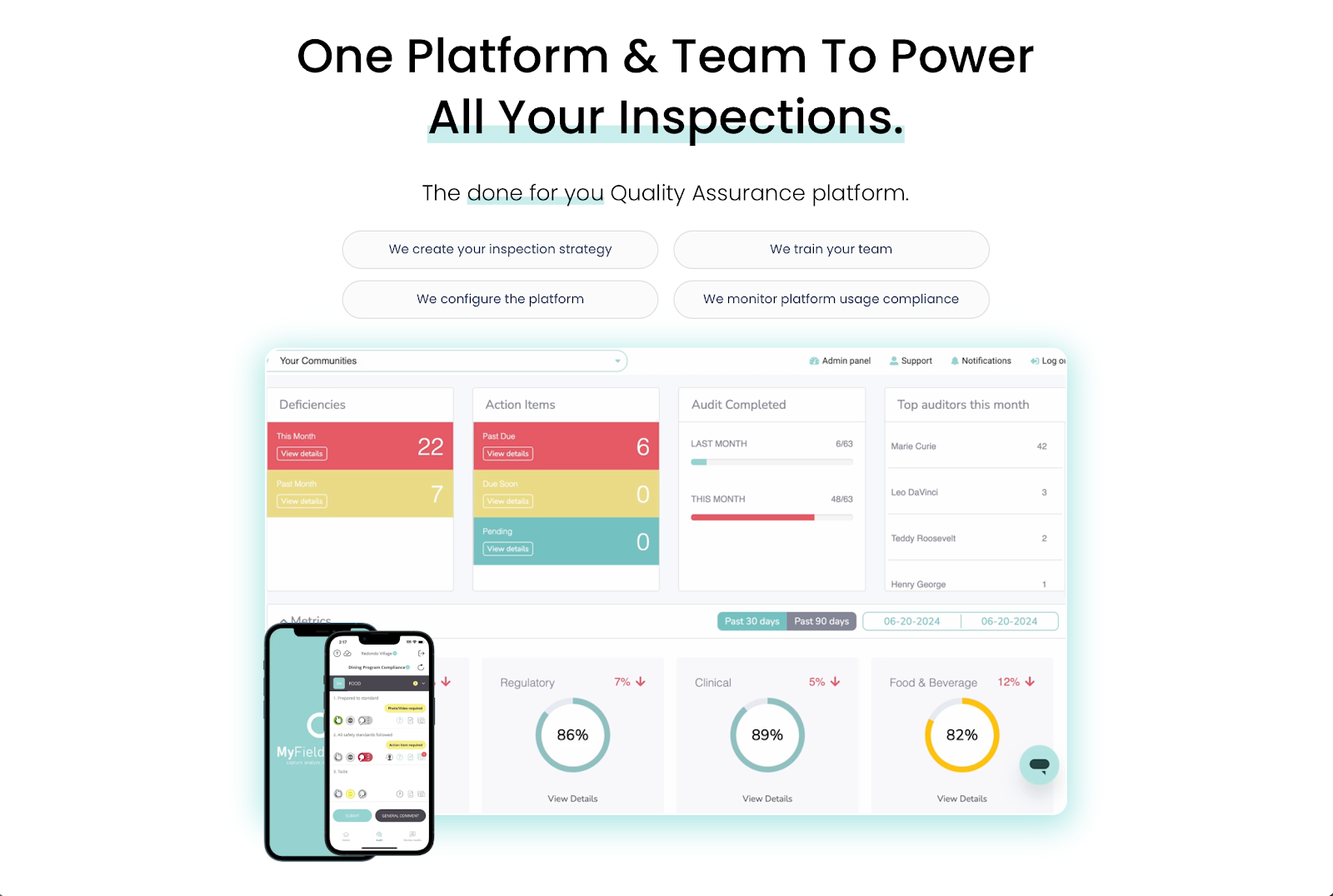
MyFieldAudits gives you the tools to do both. With a mobile app and customizable inspection forms, you can complete food safety checks anytime, spot issues early, and implement corrective actions.
You also get real-time visibility, shareable reports, and standardization across every location, all without touching a spreadsheet.
You show clients exactly what they’re paying for while building stronger relationships with inspectors. That’s how you keep scores high and contracts longer.
Book a demo today or watch this video to learn how MyFieldAudits works.
Need more information? You can also contact us by dialing (844) 344-7265.
FAQs About Health Inspection Grading Scale
What is a good inspection score?
A “good” health inspection score depends on the location of your restaurant or food business because varying cities and states use different grading scales and posting requirements.
For example, Seattle/King County uses a food safety rating system with category-style results (excellent, good, okay, needs to improve). The state requires businesses to display the ratings within five feet of the main public entrance.
On the other hand, Los Angeles County uses a letter grading system (A, B, C) that must be prominently displayed at the entrance. Always check state- or city-specific rules to interpret inspection scores correctly.
What does “C” mean in a restaurant?
The C grade signals major problems in your food service establishment. It means inspectors found several violations that may risk customer safety. You need to promptly correct these issues and face follow-up inspections.
What are the grades for NYC health inspections?
New York City uses letter grades tied to violation points. An "A" grade means 0-13 points, a "B" means 14-27 points, and a "C" means 28 points or more. The lower the score, the better the grade.
Is 90 a good sanitation score?
Yes, a score of 90 is considered good in most point-based grading systems. It shows your restaurant met most food safety standards, with only a few minor issues.
While it’s not a perfect score, it’s still a strong result that is well above the minimum passing range.



%201%20(1).svg)